How to Be Disciplined: Avoid Temptation Instead of Fighting It
 Gabriel SánchezPublished


To be more disciplined, stop planning to resist temptation and start arranging your day so you meet it less often. That's what people with high self-control do: in studies that tracked them through the day, they reported weaker temptations and resisted less often than everyone else, because they spent less time near what tempted them.
What disciplined people do differently
The best look at self-control in daily life comes from a study that beeped 205 adults several times a day for a week and asked what they wanted at that moment (Hofmann et al., 2012). People felt some desire about half the times they were beeped, and about half of those desires clashed with another goal. Resisting worked when people tried it: desires were acted on about 70% of the time without resistance and about 17% of the time with it.
The surprise was in the people with high self-control. They didn't have heroic willpower. Their desires were weaker, they felt less inner conflict and they tried to resist less often. They seemed to spend less time in situations that called for a fight.
Two other findings point the same way:
- People who score high on self-control say they avoid temptation more often, and in a lab task they were more likely to choose to work without distractions (Ent et al., 2015).
- Across six studies with more than 2,000 people, self-control predicted better grades and goal progress largely through good habits, not through effortful resistance (Galla & Duckworth, 2015).
So the disciplined person you admire is probably not winning more fights. They're having fewer of them.
Why willpower in the moment is the weakest tool
Psychologists group self-control strategies by when they act (Duckworth, Gendler & Gross, 2016). The earlier the strategy, the less effort it takes, because the urge hasn't had time to grow.
Strategy | When it acts | Example |
|---|---|---|
Choose the situation | Before you're tempted | Study at the library, not on the sofa |
Change the situation | Before you're tempted | Phone in another room, social apps locked |
Shift your attention | Once the temptation is there | Look away from the snack, focus on the next line |
Change how you see it | Once the temptation is there | "This video is the reason I'm behind" |
Hold back the response | At the last second | Pure willpower: wanting it and saying no |
Most people try to be disciplined with the last row. It's the hardest place to win and the one that fails when you're tired, stressed or bored.
How to be disciplined: 8 steps
- Pick one goal for the next month. Training four days a week, studying two hours a day, or going to bed by 11. One goal you keep beats five you drop.
- Write down what pulls you away and where. Be specific: "YouTube on the phone in bed after 10 p.m." is something you can fix; "I get distracted" is not.
- Remove the temptation from the place where the goal happens. No snacks in the desk drawer, no game console in the room where you study, no phone on the desk while you work.
- Add friction to what's left. Log out of social apps, move them off the home screen, lock them at set times or places. A few extra steps are often enough to break the automatic tap.
- Make the goal the easy option. Gym bag packed by the door, books open on the desk the night before, workout clothes on the chair. Same time and same place every day, so you're not deciding again each morning.
- Use if-then plans for the hard moments. "If it's 7 p.m., then I open my notes at the kitchen table." "If I want to check Instagram while studying, then I write the urge on a sticky note and keep going." A meta-analysis of 94 tests found these plans had a medium-to-large effect on reaching goals (Gollwitzer & Sheeran, 200638002-1)).
- Shrink the start. "Open the book and read one page" is easier to start than "study chapter 4". Most days you'll keep going once you've started.
- Review once a week. Which rule did you break and where were you? That's the next thing to change in your setup.
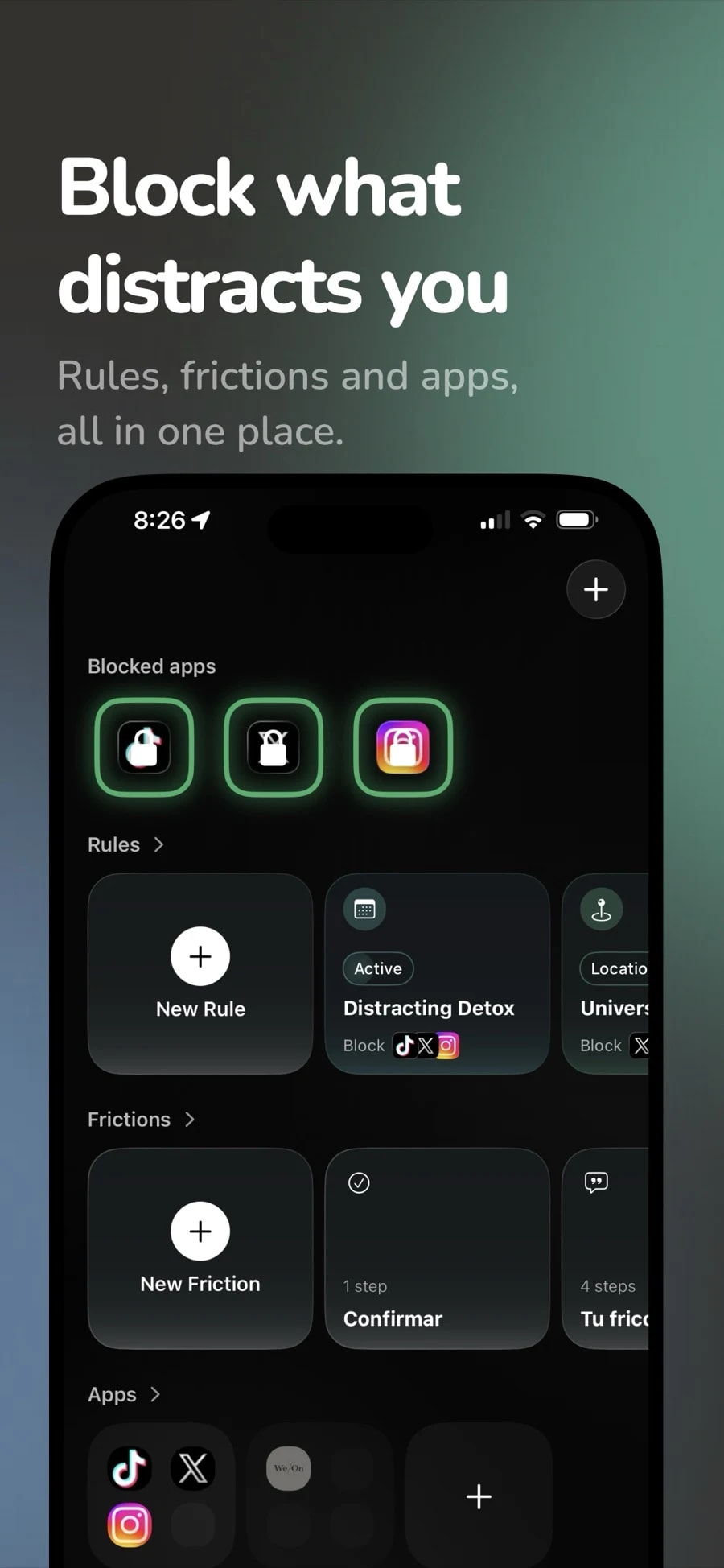
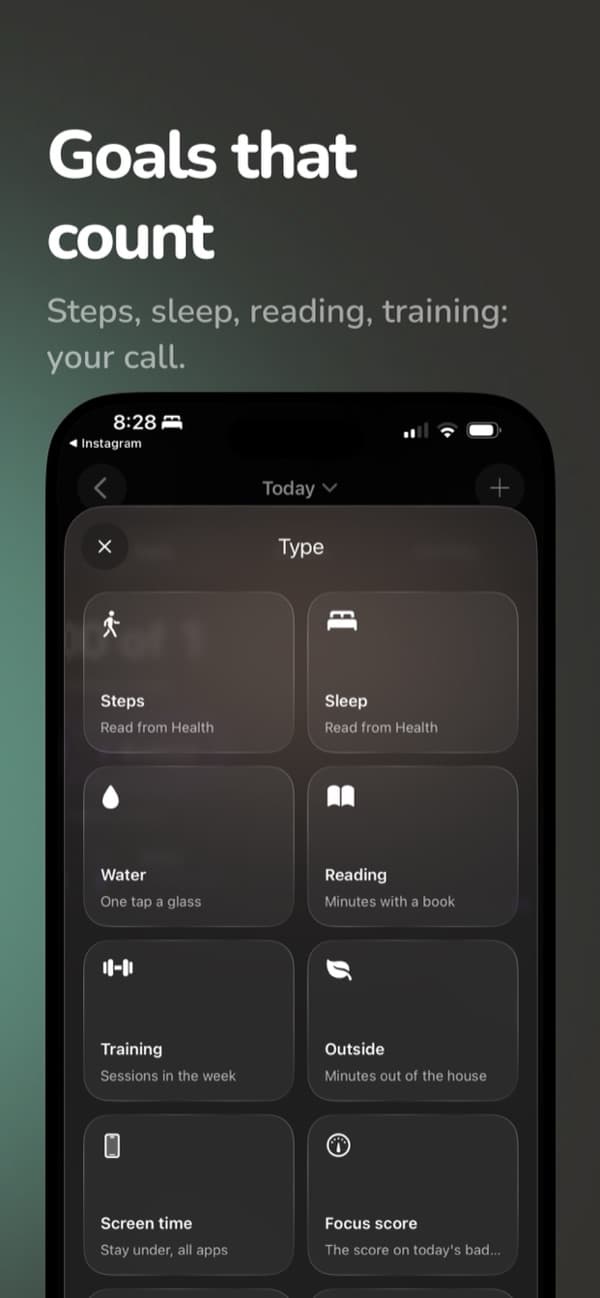
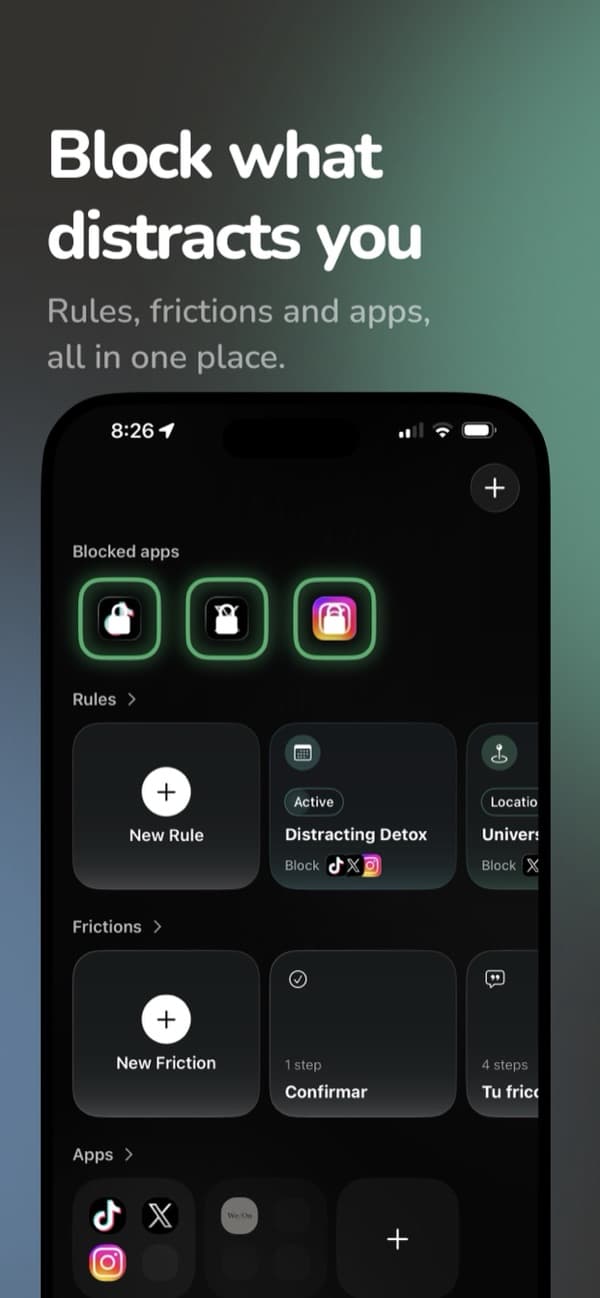
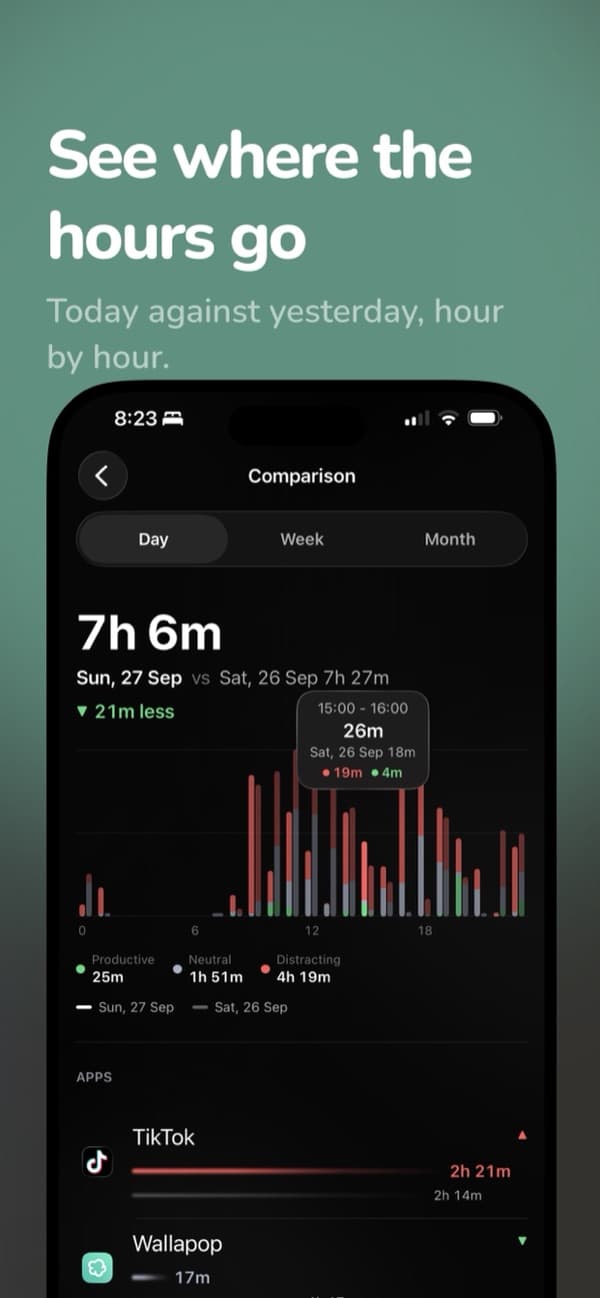

Let the phone keep the rule for you
LockTy locks the apps you choose by schedule, place or mode, so the decision is made before the temptation shows up. You can also set daily goals, like a workout or 30 minutes of reading, that unlock the apps once they're done.
Example: a week of studying with less willpower
The numbers here are an example, not a recommendation. Say you want to study two hours a day for an exam and keep losing the evenings to your phone.
Change | What it replaces |
|---|---|
Study at the library from 6 to 8 p.m. | Studying on the bed "after one video" |
Phone in the locker or bag, social apps locked until 8 p.m. | Phone face up next to the laptop |
If-then: "If I sit down, I open yesterday's notes first" | Deciding where to start every day |
Book and notes stay in the bag, ready | Packing every evening |
Sunday review: where did I slip? | Promising to "try harder" |
Nothing on that list asks you to be stronger. It asks you to decide once and let the setup handle the other six days.
Common mistakes
- Relying on motivation. It's high on Monday and gone by Thursday. Set up the week while you still have it.
- Fixing everything at once. A new diet, 5 a.m. wake-ups and no phone, all starting the same day, usually falls apart within a week.
- Leaving the temptation in reach "to test yourself". That's practising the hardest strategy on purpose.
- Treating one bad day as failure. In habit research, missing a single day didn't derail the habit (Lally et al., 2010). Get back to it the next day.
How long it takes
Expect the first two weeks to feel effortful. In the habit study above, people needed a median of 66 days for a daily behavior to feel automatic, with a wide range from 18 to 254 days (Lally et al., 2010). The habit formation calculator shows those dates from the day you start.
If the goal is to get your phone under control first, start with how to stop phone addiction. If you want a stricter 30 to 90 day block, read what monk mode is. A good place to practise all of this is the first hour of the day: here's a morning routine that starts without your phone.
Frequently asked questions
Can self-discipline be learned?
Yes, mostly through what you change around you. Studies of people with high self-control find they rely on habits and on avoiding tempting situations more than on resisting in the moment, and those are things anyone can set up.
Why do I have no self-discipline?
Usually because the temptation is closer and easier than the goal. If your phone is on the desk and the textbook is in your bag, the phone wins most days. Change the setup before you blame your character.
How do I become disciplined every day?
Make the right action the default: same time, same place, as few decisions as possible. Decide the hard choices in advance with if-then plans, and remove or lock what usually pulls you away.
Is discipline better than motivation?
Motivation comes and goes during the day. Discipline, in practice, is a set of routines and rules that still work when motivation is low. You need a reason to start, then a setup that carries you on the bad days.
How long does it take to become disciplined?
There's no single number. In one study of new daily habits, the median time to feel automatic was 66 days, with a range of 18 to 254 days. Missing one day did not undo the progress.
LockTy
Lock the apps that distract you and unlock them by meeting your daily goals: steps, sleep, reading or training.
Sources
- Hofmann W, Baumeister RF, Förster G, Vohs KD (2012). Everyday temptations: an experience sampling study of desire, conflict, and self-control. Journal of Personality and Social Psychology 102(6):1318–1335.
- Ent MR, Baumeister RF, Tice DM (2015). Trait self-control and the avoidance of temptation. Personality and Individual Differences 74:12–15.
- Duckworth AL, Gendler TS, Gross JJ (2016). Situational strategies for self-control. Perspectives on Psychological Science 11(1):35–55.
- Galla BM, Duckworth AL (2015). More than resisting temptation: beneficial habits mediate the relationship between self-control and positive life outcomes. Journal of Personality and Social Psychology 109(3):508–525.
- Gollwitzer PM, Sheeran P (2006). Implementation intentions and goal achievement: a meta-analysis of effects and processes. Advances in Experimental Social Psychology 38:69–119.
- Lally P, van Jaarsveld CHM, Potts HWW, Wardle J (2010). How are habits formed: modelling habit formation in the real world. European Journal of Social Psychology 40(6):998–1009.

About the author
22, software developer and founder based in Madrid.
I'm Gabriel, I'm 22 and I live in Madrid. I write software, build my own products and I'm into maths, sport and fashion. Among other things I make three iPhone apps, Creatinely, LockTy and RepZet, and here I write about training, creatine and the small daily habits that add up. I also build apps and software for B2B clients as an independent developer. If you want to work together, write to me.
This is general information, not medical advice. Talk to a professional about your own situation.
Keep reading

Morning Routine: A Simple Plan That Starts Without Your Phone
A good morning routine is short, happens at the same time daily and starts before your phone. A 10, 30 and 60 minute version, plus how to make it stick.

Dopamine Detox: What It Gets Right and What It Gets Wrong
A dopamine detox can't lower or reset your dopamine. The useful part of the trend is cutting easy, high-reward habits at set times and getting used to boredom.

How to Set Daily Goals You Can Keep: 7 Steps and Examples
Set 3 to 5 daily goals you can measure, tie each to a time and place, and tick them off the same day. Here's how, with examples for steps, sleep and reading.

How to Stop Procrastinating: 10 Steps That Work When Willpower Doesn't
To stop procrastinating, make the first step tiny, decide in advance when and where you'll start, and keep your phone out of reach while you work.
How to Stop Phone Addiction: 9 Changes That Beat Willpower
Use your phone less by changing your setup, not your willpower: fewer notifications, distracting apps locked at set times and the phone out of the bedroom.
What Is Monk Mode? A 30-Day Plan That Starts With Your Phone
Monk mode is a set period, often 30 to 90 days, to cut distractions and focus on one or two goals. Start with your phone and rules you decide in advance.