Arnold Split: The Full 6-Day Program, Who It Suits and a 4-Day Version
 Gabriel SánchezPublished


The Arnold split is a six-day routine built from three sessions: chest and back, shoulders and arms, and legs. You do the three in order, repeat them, and rest on the seventh day, so every muscle gets trained twice a week. It suits lifters who already train consistently and can recover from six sessions. Beginners and anyone short on time or sleep will usually do better on four days.
What the Arnold split is and where it comes from
The name comes from Arnold Schwarzenegger's training in the 1970s. The source most guides point to is his book with Bill Dobbins, The New Encyclopedia of Modern Bodybuilding. Its advanced chapter is built around high-set training and double-split training, which means two sessions in the same day (Schwarzenegger & Dobbins, 1998).
What gyms call the Arnold split today is a simpler, one-session-a-day version of that idea. Three pairings make it different from other splits:
- Chest with back. These muscles work in opposite directions, so you can alternate a press and a pull and let one rest while the other works.
- Shoulders with arms. Biceps and triceps get a full session of their own instead of the leftovers after chest or back.
- Legs alone. Squats, hinges, hamstrings and calves get a whole day.
The full 6-day Arnold split program
The layout:
Day | Session |
|---|---|
Monday | Chest and back (A) |
Tuesday | Shoulders and arms (A) |
Wednesday | Legs (A) |
Thursday | Chest and back (B) |
Friday | Shoulders and arms (B) |
Saturday | Legs (B) |
Sunday | Rest |
Each table below lists the exercises for the first half of the week (A) and the swap for the second half (B). Same sets and reps on both days. Stop each set with one or two reps left in the tank.
Chest and back (Monday and Thursday)
Exercise (A) | Sets × reps | Swap on day B |
|---|---|---|
Barbell bench press | 3 × 6–8 | Incline barbell press |
Pull-up or lat pulldown | 3 × 6–10 | Chin-up or neutral-grip pulldown |
Incline dumbbell press | 3 × 8–12 | Flat dumbbell press |
Barbell row | 3 × 8–12 | Seated cable row |
Dumbbell pullover | 2 × 10–12 | Straight-arm pulldown |
Cable fly | 2 × 12–15 | Dips |
You can pair each press with the pull below it and alternate sets. That saves time on a 16-set day. For more options, see the best chest exercises and the back and bicep workout.
Shoulders and arms (Tuesday and Friday)
Exercise (A) | Sets × reps | Swap on day B |
|---|---|---|
Overhead press | 3 × 6–10 | Arnold press (seated dumbbells) |
Lateral raise | 4 × 12–15 | Cable lateral raise |
Reverse fly | 3 × 12–15 | Face pull |
Barbell curl | 3 × 8–12 | Hammer curl |
Close-grip bench press | 3 × 8–12 | Skull crusher |
Incline dumbbell curl | 2 × 10–12 | Cable curl |
Overhead cable triceps extension | 2 × 10–15 | Triceps pushdown |
Lateral raises get four sets because presses work the side delts much less than the front delts. The rear delt exercises and best tricep exercises guides have more swaps if something hurts.
Legs (Wednesday and Saturday)
Exercise (A) | Sets × reps | Swap on day B |
|---|---|---|
Back squat | 4 × 5–8 | Front squat or hack squat |
Romanian deadlift | 3 × 8–10 | 45° back extension |
Leg press | 3 × 10–12 | Bulgarian split squat |
Lying leg curl | 3 × 10–12 | Seated leg curl |
Standing calf raise | 4 × 10–15 | Seated calf raise |
Hanging leg raise | 3 × 10–15 | Cable crunch |
The leg day workout explains each lift and gives home swaps.
What that adds up to
Counting only direct sets, the week gives chest about 16 sets, back about 14 to 16, quads 14, hamstrings 12, biceps and triceps 10 each, and side delts 8. Pressing and rowing add more work for shoulders and arms on top of that. A 2017 meta-analysis found that more weekly sets led to more growth, with the best results at 10 or more sets per muscle per week (Schoenfeld et al., 2017). So this program clears that line for every major muscle. Run your own numbers through the weekly sets calculator if you change exercises.
Weekly Sets Calculator: How Many Sets Per Muscle Per Week?Count your weekly sets per muscle after you set up your Arnold split.Who the Arnold split suits, and who should skip it
Training a muscle twice a week has decent support. A 2016 meta-analysis found more growth from twice-weekly training than from once a week (Schoenfeld et al., 2016). A later one that matched total volume found that frequency itself mattered little, and that its main use is spreading out your sets (Schoenfeld et al., 2019). The Arnold split gets you to two sessions a week per muscle. Whether that works for you depends on recovery and schedule.
It suits you if:
- You have trained steadily for a while and progress has slowed on three or four days.
- You can be in the gym six days a week, most weeks.
- You sleep and eat enough to recover from about 110 hard sets a week.
- You like long, focused sessions per body part, especially for arms and shoulders.
Skip it, or use the shorter version below, if:
- You are a beginner. The ACSM progression guidelines suggest two to three full-body days a week for novices and keep four to six days for advanced lifters (Ratamess et al., 2009). Six days adds fatigue a beginner doesn't need.
- You often miss days. Missing one session on a six-day plan pushes everything else back.
- Your shoulders or elbows complain. Monday's presses are followed by Tuesday's overhead press and triceps work, so the front delts and triceps get worked on back-to-back days.
- You are in a big calorie deficit or sleeping badly. Recovery is the first thing to suffer.
The 4-day and 5-day Arnold split
If six days is too many, keep the pairings and drop sessions. The trick is to use exercises that cover two jobs: chin-ups train back and biceps, and dips train chest and triceps.
Days | Layout | What changes |
|---|---|---|
4 | Chest and back, legs, rest, shoulders and arms, legs, rest, rest | Start the shoulder and arm day with 3 sets of chin-ups and 3 of dips, so chest and back get a second, lighter dose |
5 | Chest and back, legs, shoulders and arms, rest, chest and back, legs, rest | Shoulders and arms get one direct day; the two chest and back days already give them indirect work |
Rolling (about 5) | Three days on, one day off, repeat | Same sessions as the full program, with a rest day every fourth day. The weekdays shift each week |
On four days, add a set to the main lifts of each session so the weekly total doesn't drop too far. Check it with the calculator above.
Arnold split vs. PPL vs. upper/lower
Arnold split | Push/pull/legs | Upper/lower | |
|---|---|---|---|
Days a week | 6 | 6 (or 3) | 4 |
Each muscle per week | 2 times | 2 times (1 on 3 days) | 2 times |
Sessions | Chest and back / shoulders and arms / legs | Chest, shoulders, triceps / back, biceps / legs | Whole upper body / whole lower body |
Strong point | Arms and shoulders trained fresh | Muscles that work together rest together | Fewer gym days for the same frequency |
Weak point | Presses on back-to-back days | Arms always come last | Long upper-body sessions |
When the weekly sets are the same, studies haven't found that one way of dividing the body builds more muscle or strength. A 2024 meta-analysis comparing split routines with full-body training found no difference (Ramos-Campo et al., 2024). So the choice comes down to how many days you can train and which sessions you'll actually look forward to.
How to progress on the Arnold split
Use the rep ranges in the tables. When you hit the top of the range on every set of an exercise, add weight next time and start again from the bottom. That is progressive overload in its simplest form.
Example with made-up numbers: Monday you bench 80 kg for 8, 7 and 6. You stay at 80 kg until you get 8, 8 and 8, then move to 82.5 kg and work back up from 6. To set first-week weights, estimate your max from a recent set with the one-rep max calculator.
Write every set down. You train each session twice a week, so on Thursday you need to know exactly what you did on Monday.
Common mistakes
- Doing Arnold's volume. Pro bodybuilders' double-split days are not a starting point. Use the program above and add sets only if you keep progressing and recover well. The sets per week guide shows where to stop.
- Skipping the second leg day. Many people keep both arm days and quietly drop one leg day. That halves your leg training.
- Going to failure on every set. Leave a rep or two in reserve, especially on squats and presses.
- Changing exercises every week. Keep the A and B lists for at least six to eight weeks so you can see progress.
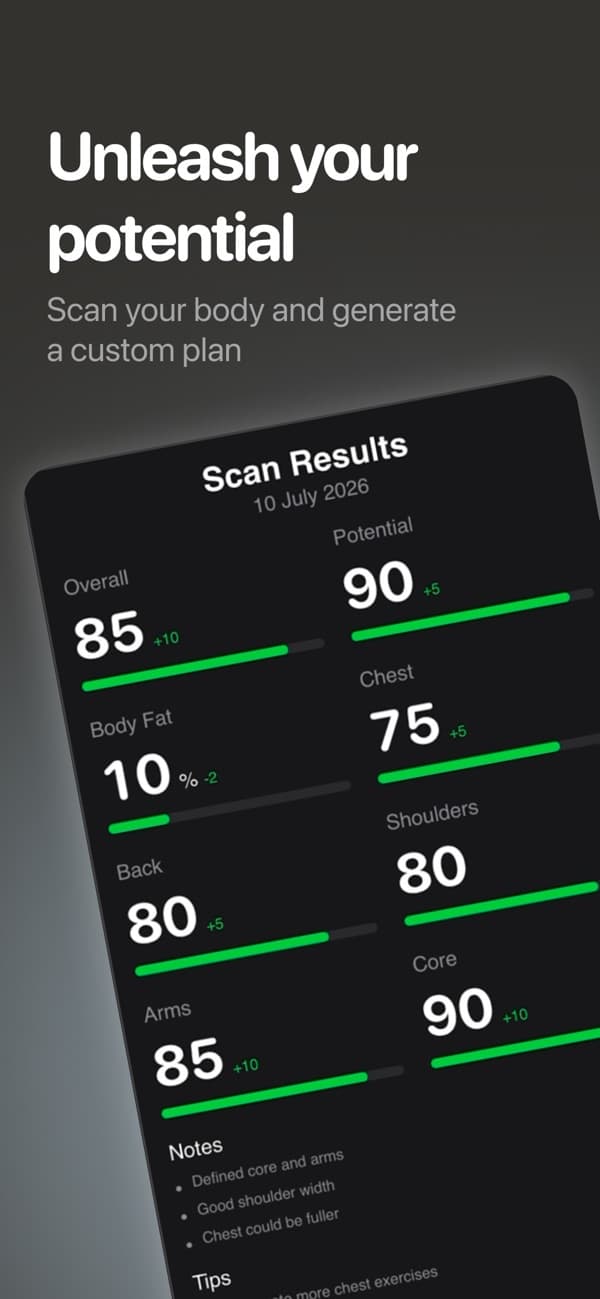
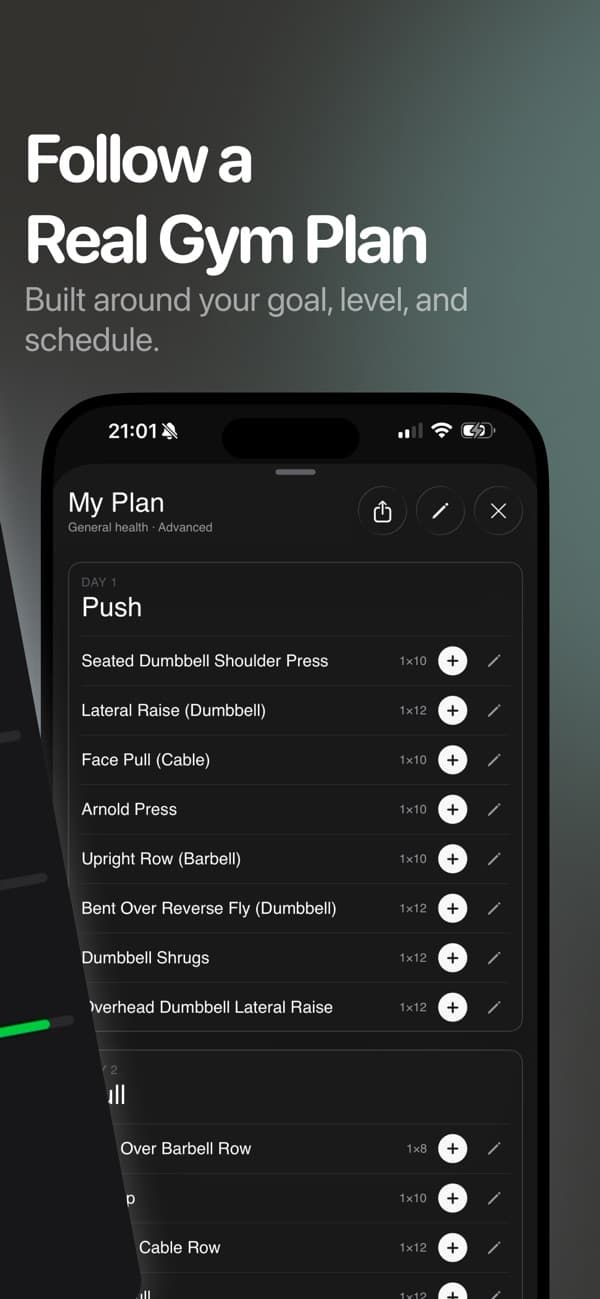
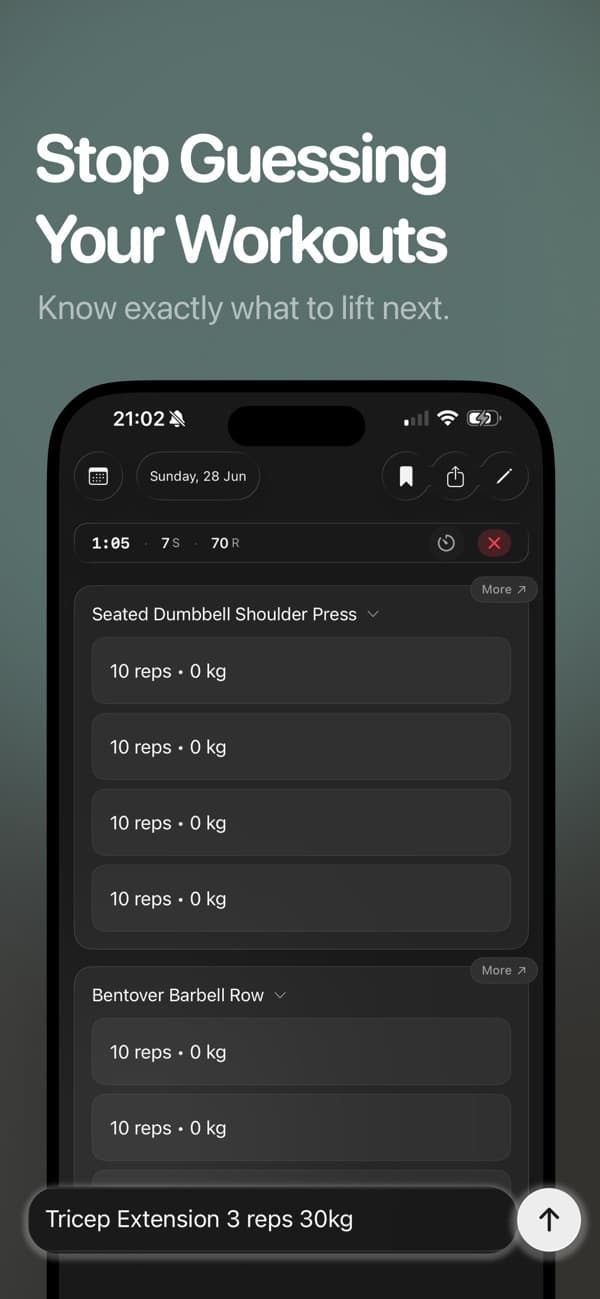

Want the Arnold split adapted to your body?
Discover the routine that fits your body best with a simple scan.
If you have pain that gets worse from session to session, a past injury or a heart condition, talk to a doctor or physical therapist before moving to six training days.
Frequently asked questions
What is the Arnold split?
A six-day bodybuilding split with three sessions: chest and back, shoulders and arms, and legs. You run the three in order, then repeat them, so every muscle is trained twice a week. Most versions take Sunday off.
Is the Arnold split good for beginners?
Usually not. Six days of high volume is more than a beginner needs. The ACSM's progression guidelines suggest two to three full-body days a week for novices and keep four to six days for advanced lifters. Start with fewer days and move to the Arnold split once you can recover from more.
Is the Arnold split good for hypertrophy?
Yes, if you can recover from it. It trains each muscle twice a week and makes it easy to reach 10 or more hard sets per muscle, which is where a 2017 meta-analysis found the most growth. It isn't better than other splits with the same weekly sets, though.
Is the Arnold split better than push pull legs?
Neither is better for muscle growth when weekly sets are equal. The Arnold split gives arms and shoulders their own fresh day. PPL groups muscles that work together, so pressing muscles get more rest between sessions. Pick the one you enjoy and can keep up.
How long does an Arnold split workout take?
With the program in this article, about an hour. Each session has 16 to 20 sets. At roughly one minute per set and two minutes of rest, 20 sets take about 60 minutes plus a warm-up.
Can I do the Arnold split 4 days a week?
Yes, with changes. Train chest and back, then legs, then shoulders and arms, then legs again, and add chin-ups and dips to the arm day so chest and back still get a second, lighter dose each week.
RepZet
Take a quick test and scan your body to get a 100% personalized routine built around your weak points.
Sources
- Schwarzenegger A, Dobbins B (1998). The New Encyclopedia of Modern Bodybuilding. Simon & Schuster. Book Two, Chapter 5: The Advanced Training Program.
- Schoenfeld BJ, Ogborn D, Krieger JW (2016). Effects of resistance training frequency on measures of muscle hypertrophy: a systematic review and meta-analysis. Sports Medicine 46(11):1689–1697.
- Schoenfeld BJ, Grgic J, Krieger J (2019). How many times per week should a muscle be trained to maximize muscle hypertrophy? A systematic review and meta-analysis. Journal of Sports Sciences 37(11):1286–1295.
- Schoenfeld BJ, Ogborn D, Krieger JW (2017). Dose-response relationship between weekly resistance training volume and increases in muscle mass: a systematic review and meta-analysis. Journal of Sports Sciences 35(11):1073–1082.
- Ramos-Campo DJ et al. (2024). Efficacy of split versus full-body resistance training on strength and muscle growth: a systematic review with meta-analysis. Journal of Strength and Conditioning Research 38(7):1330–1340.
- Ratamess NA et al. (2009). American College of Sports Medicine position stand. Progression models in resistance training for healthy adults. Medicine & Science in Sports & Exercise 41(3):687–708.

About the author
22, software developer and founder based in Madrid.
I'm Gabriel, I'm 22 and I live in Madrid. I write software, build my own products and I'm into maths, sport and fashion. Among other things I make three iPhone apps, Creatinely, LockTy and RepZet, and here I write about training, creatine and the small daily habits that add up. I also build apps and software for B2B clients as an independent developer. If you want to work together, write to me.
This is general information, not medical advice. Talk to a professional about your own situation.
Keep reading

How Many Sets per Week to Build Muscle? (What the Studies Say per Muscle)
Most research supports about 10 to 20 hard sets per muscle per week to build muscle. How to count sets, split them across the week and know when to add more.
Double Progression Explained: When to Add Weight and How Much
Double progression: keep the weight, add reps until every set hits the top of your range, then add a little weight and start again. Rep ranges, jumps, examples.

How to Calculate Your One Rep Max (Epley and Brzycki Formulas, With a % Table)
Estimate your one rep max from a set of 10 reps or fewer with the Epley or Brzycki formula. Worked examples, a percentage table and when to test a true max.

How to Progressive Overload Without Adding Weight (6 Methods With Examples)
You can progressive overload without adding weight by doing more reps, adding sets, slowing the lowering phase or using a fuller range of motion. How and when.
What Is Progressive Overload? Definition, Methods and Real Examples
Progressive overload means asking a bit more of your muscles over time: more weight, reps or sets. What it is, the ways to apply it and examples you can copy.