How to Calculate Your One Rep Max (Epley and Brzycki Formulas, With a % Table)
 Gabriel SánchezPublished
To calculate your one rep max, take a set of 10 reps or fewer done close to failure and use a formula: Epley is weight × (1 + reps ÷ 30) and Brzycki is weight ÷ (1.0278 − 0.0278 × reps). For example, 80 kg for 6 reps gives an estimated max of 96 kg with Epley and about 93 kg with Brzycki.
What a one rep max is
Your one rep max (1RM) is the heaviest weight you can lift once with full range of motion and good technique. Coaches use it to set training weights as percentages, and lifters use it to see if they are getting stronger.
You can find it two ways: test it directly by working up to a single heavy rep, or estimate it from a set of several reps with a lighter weight. Most people should estimate.
The two formulas most calculators use
The Epley formula comes from strength coach Boyd Epley's 1985 poundage chart:
1RM = weight × (1 + reps ÷ 30)
The Brzycki formula was published by Matt Brzycki in 1993. He based it on observations that the number of reps you can do falls in a nearly straight line as the weight approaches your max, with about 10 reps possible at 75% of your 1RM (Brzycki, 1993):
1RM = weight ÷ (1.0278 − 0.0278 × reps)
Brzycki also wrote that the relationship stops being close to linear beyond about 10 reps, so his formula is only valid for sets of fewer than about 10 reps.
Two worked examples:
Set | Epley | Brzycki |
|---|---|---|
80 kg × 6 | 80 × 1.2 = 96.0 kg | 80 ÷ 0.861 = 92.9 kg |
100 kg × 5 | 100 × 1.167 = 116.7 kg | 100 ÷ 0.889 = 112.5 kg |
The two formulas agree at 10 reps and drift apart below that, with Epley giving the higher number. The one rep max calculator runs both for you.
Percentage table: reps to % of 1RM
The same formulas work backwards. If you know your max, they tell you roughly how many reps you should manage at a given weight. The last column is the classic table from a common strength training textbook, as reproduced by Nuzzo et al., 2024.
Reps to failure | Epley (% of 1RM) | Brzycki (% of 1RM) | Textbook table (% of 1RM) |
|---|---|---|---|
2 | 93.8 | 97.2 | 95 |
3 | 90.9 | 94.4 | 93 |
4 | 88.2 | 91.7 | 90 |
5 | 85.7 | 88.9 | 87 |
6 | 83.3 | 86.1 | 85 |
8 | 78.9 | 80.5 | 80 |
10 | 75.0 | 75.0 | 75 |
12 | 71.4 | 69.4 | 67 |
To use it: if your estimated bench max is 100 kg and you want sets of 8, start around 78 to 80 kg. Then let your reps tell you whether to go up or down next time. The plate calculator shows which plates to put on each side.
How accurate are 1RM estimates?
Estimates are averages, and real people vary. Nuzzo and colleagues pooled 952 reps-to-failure tests from 269 studies, covering 7,289 people, to update the classic table (Nuzzo et al., 2024). Three findings matter for anyone using a calculator:
- At lighter loads people did more reps than the old table predicts. At 70% of 1RM the average was about 15 reps, against 11 in the textbook table.
- The exercise matters. At 70% of 1RM, people averaged about 14 reps on the bench press but about 19 on the leg press.
- People differ more at lighter loads. The spread between individuals was about 2.5 reps at 80% of 1RM and about 4.4 reps at 60%.
In practical terms, an estimate from a heavy set of 3 to 6 reps is likely to land closer to your true max than one from a set of 12 or 15. That fits Brzycki's own limit of 10 reps.
Two more things throw estimates off:
- Stopping short. The formulas assume you could not have done another rep. If you stopped with three reps left, the result will be too low.
- Changing technique. A set with half-depth squats will estimate a max you can't lift with full depth.
So use the same formula, the same exercise and the same depth every time, and treat the result as a trend line for your own progress. Brzycki made the same point: compare a lifter's result with their own last performance, not with other people's.
When to test a true max instead
Brzycki's article lists the reasons to estimate rather than test. Lifting a true max puts a lot of stress on muscles and connective tissue, raises blood pressure more than lighter sets, and is a skill that takes practice (Brzycki, 1993).
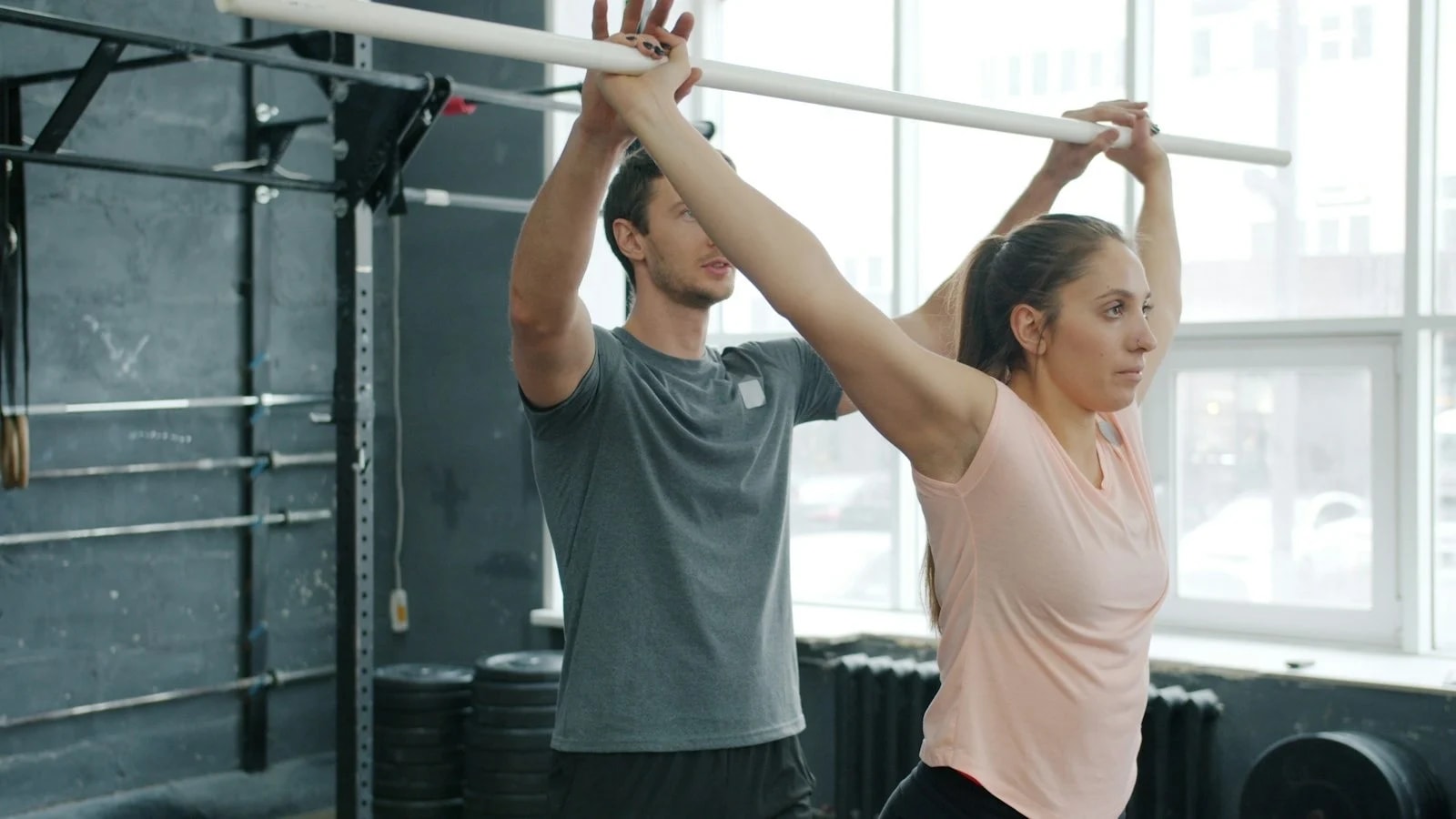
Testing makes sense if you compete in powerlifting, if your program is built on exact percentages, or if you are an experienced lifter with consistent technique who wants a real number. If you test:
- Warm up with a few lighter sets, for example the bar for 10, then about 50% for 5, 70% for 3, 80% for 1 and 90% for 1.
- Rest about 3 to 5 minutes between heavy attempts. The ACSM recommends 3 to 5 minutes between sets when training with heavy loads (ACSM, 2009).
- Use safety bars or a spotter on the squat and bench press.
- Stop when your form breaks down or when you feel any sharp pain, even if you think you had more.
A max is only worth testing on a day when you are fresh. If your warm-ups feel unusually heavy, keep your estimate and try another day.
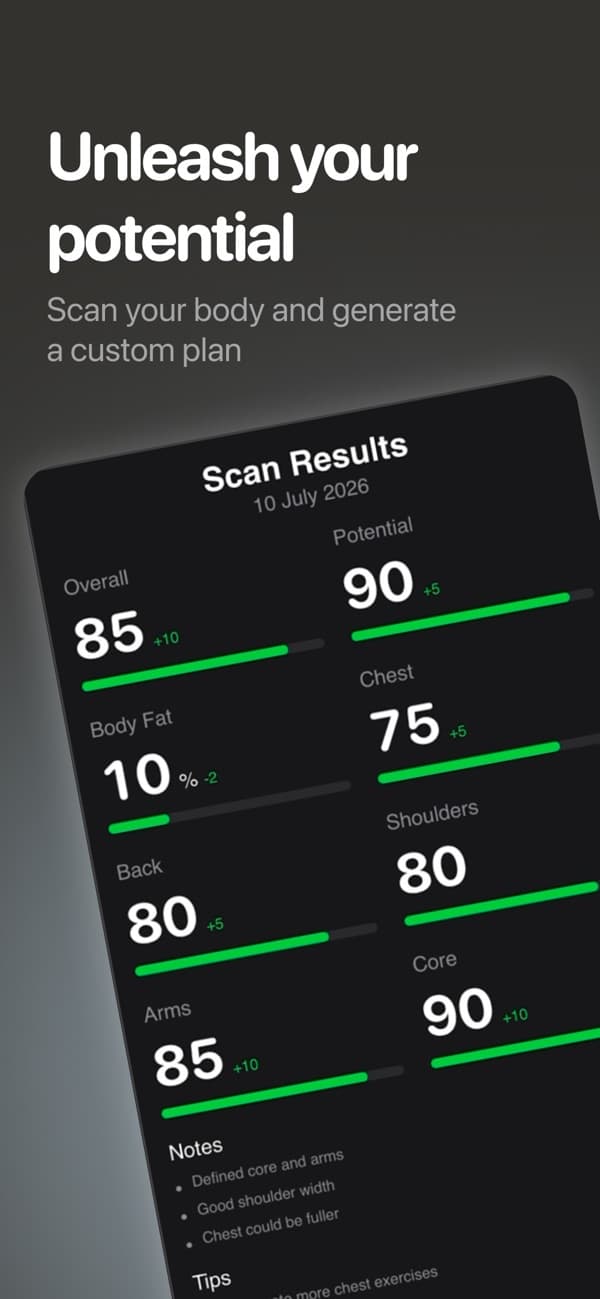
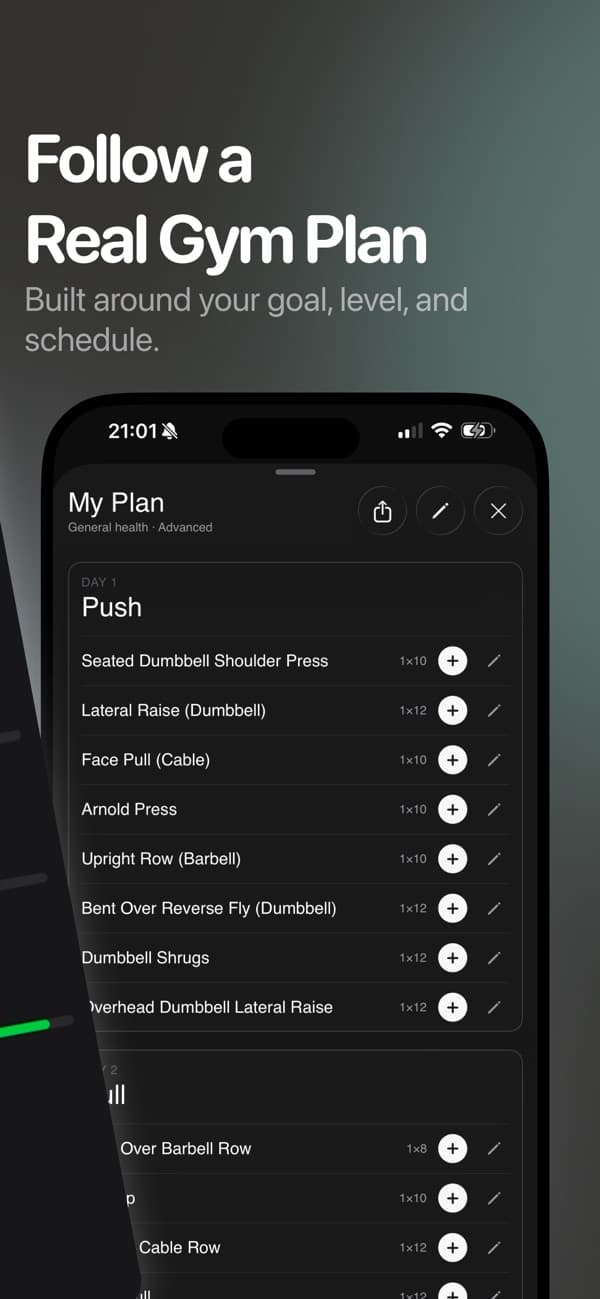
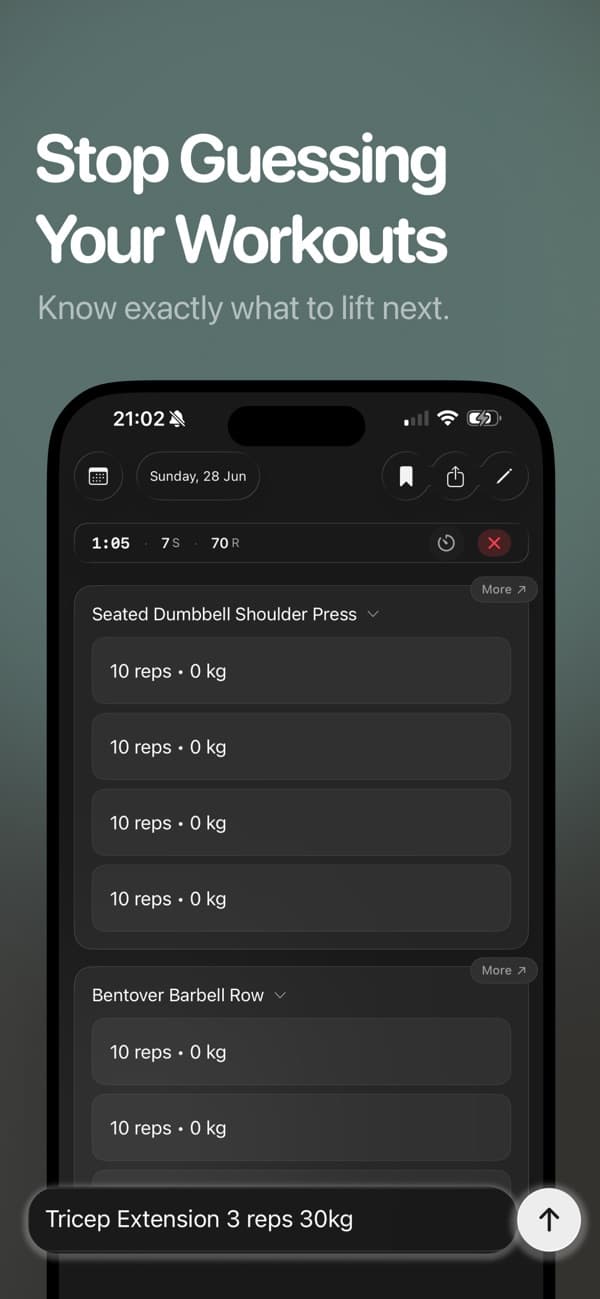

If you'd rather watch your max go up without testing it
RepZet lets you log sets by typing them like a message and suggests what to beat next session, so your heavy sets keep moving up between tests. (I make RepZet.)
How to use your 1RM in training
For strength, heavier loads help most. The ACSM's 2026 position stand found that strength was enhanced by lifting loads of 80% of 1RM or more, through a full range of motion (Currier et al., 2026). In the table above, that is roughly sets of 8 reps or fewer.
For muscle growth, the same review found that the load, anywhere from 30% to 100% of 1RM, did not change how much muscle people built. So you don't need to know your max to build muscle. Picking a rep range and adding reps or weight over time does the job, as in double progression.
Your estimated max is most useful as a scoreboard. If it goes up every few weeks on your main lifts, your progressive overload is working. If it has been flat for a month, change one thing, such as the rep range or the number of sets per week.
Next time you do a hard set of 3 to 8 reps, run it through a formula and write the number down.
Frequently asked questions
Which 1RM formula is the most accurate?
No single formula is the most accurate for every lift and every person, because the number of reps people can do at a given percentage varies by exercise and between individuals. Pick one formula and use it consistently so your estimates are comparable over time.
How many reps should I use to estimate my 1RM?
Use a set of 10 reps or fewer. Brzycki wrote that his formula is only valid below about 10 reps, and estimates from heavier, lower-rep sets leave less room for error.
How often should I test my one rep max?
Most lifters don't need to test it often. An estimate from your regular working sets updates every session, and a true max test makes sense only when you need an exact number, such as before a competition or a percentage-based program.
Is testing a true one rep max safe?
For experienced lifters with solid technique, a thorough warm-up and a spotter or safety bars, max singles are a normal part of strength sports. Beginners get most of the useful information from an estimate without the extra risk.
Sources
- Brzycki M (1993). Strength testing: predicting a one-rep max from reps-to-fatigue. Journal of Physical Education, Recreation & Dance 64(1):88–90.
- Nuzzo JL et al. (2024). Maximal number of repetitions at percentages of the one repetition maximum: a meta-regression and moderator analysis of sex, age, training status, and exercise. Sports Medicine 54:303–321.
- American College of Sports Medicine (2009). Progression models in resistance training for healthy adults. Medicine & Science in Sports & Exercise 41(3):687–708.
- Currier BS et al. (2026). ACSM Position Stand. Resistance training prescription for muscle function, hypertrophy, and physical performance in healthy adults: an overview of reviews. Medicine & Science in Sports & Exercise 58(4):851–872.
About the author
22, software developer and founder based in Madrid.
I'm Gabriel, I'm 22 and I live in Madrid. I write software, build my own products and I'm into maths, sport and fashion. Among other things I make three iPhone apps, Creatinely, LockTy and RepZet, and here I write about training, creatine and the small daily habits that add up.
This is general information, not medical advice. Talk to a professional about your own situation.
Keep reading
Double Progression Explained: When to Add Weight and How Much
Double progression: keep the weight, add reps until every set hits the top of your range, then add a little weight and start again. Rep ranges, jumps, examples.

How Many Sets per Week to Build Muscle? (What the Studies Say per Muscle)
Most research supports about 10 to 20 hard sets per muscle per week to build muscle. How to count sets, split them across the week and know when to add more.

How to Progressive Overload Without Adding Weight (6 Methods With Examples)
You can progressive overload without adding weight by doing more reps, adding sets, slowing the lowering phase or using a fuller range of motion. How and when.