How Many Sets per Week to Build Muscle? (What the Studies Say per Muscle)
 Gabriel SánchezPublished
To build muscle, most research supports doing about 10 to 20 hard sets per muscle group per week, and the ACSM's 2026 position stand found that growth was enhanced at 10 or more weekly sets. More sets usually means more growth, but each extra set adds less, so start near 10 and add sets only while you recover and keep getting stronger.
What the research says
The first big analysis on this question pooled 15 studies and found a graded dose-response: each extra weekly set was linked to a slightly larger gain in muscle size, about 0.37% per set on average. When the studies were grouped into fewer than 5, 5 to 9 and 10 or more sets per muscle per week, the trend favored the highest group (Schoenfeld et al., 2017).
Later work looked at where the benefit starts to flatten. A review limited to trained 18- to 35-year-olds compared low (fewer than 12), moderate (12 to 20) and high (more than 20) weekly sets. Moderate and high volumes gave similar growth in the quadriceps and biceps, while the triceps grew more with high volume, and the authors suggested 12 to 20 weekly sets per muscle as a standard recommendation for young trained men (Baz-Valle et al., 2022).
The largest analysis so far, with 67 studies and 2,058 participants, found that muscle growth and strength both keep rising as weekly sets increase, with diminishing returns. The returns faded much faster for strength than for size (Pelland et al., 2026).
The ACSM's 2026 position stand, which reviewed 137 systematic reviews, summed it up for practice: muscle growth was enhanced by higher volumes of 10 or more sets per muscle group per week (Currier et al., 2026).
Weekly hard sets per muscle | How to use it |
|---|---|
Fewer than 10 | Fine for maintaining, for very busy weeks and for your first weeks in the gym |
10 to 20 | The range most studies support for building muscle |
More than 20 | Can add some growth for some muscles, with smaller returns per set. Only if you recover well |
What counts as a set
Not every set is equal, so it helps to agree on what you are counting.
Count working sets, not warm-ups. A set counts when it ends close to failure with good technique. You don't need to go all the way to failure: the ACSM's 2026 review found that training to momentary failure did not consistently change muscle growth (Currier et al., 2026). Stopping one or two reps before failure is a good default.
Count indirect work as half. A bench press trains the chest directly but also works the triceps. Pelland and colleagues compared ways of counting this and found the strongest evidence for the fractional method, where a set counts as 1 for the muscle it targets and 0.5 for muscles that help (Pelland et al., 2026).
An example for biceps in one week:
- 6 sets of rows and pulldowns count as 3 biceps sets (6 × 0.5).
- 6 sets of curls count as 6.
- Total: 9 biceps sets, just under the 10-set mark.
The weekly sets calculator does this counting for every muscle from your current routine.
How to split your sets across the week
When total weekly sets were the same, a meta-analysis of 25 studies found no meaningful difference in muscle growth between training a muscle once, twice or three or more times per week. The authors concluded you can choose your frequency based on preference (Schoenfeld et al., 2019).
In practice, splitting helps you hit the total with good sets. Doing 16 sets for your legs in one session means the last sets are done tired. Split into two sessions of 8, each set gets more effort. A sample week on an upper/lower split, trained four days a week:
Muscle | Session A | Session B | Weekly sets |
|---|---|---|---|
Chest | Bench press 3, incline dumbbell press 2 | Machine press 3, cable fly 2 | 10 |
Back | Row 3, pulldown 3 | Pull-up 3, chest-supported row 3 | 12 |
Quads | Squat 3, leg extension 2 | Leg press 3, split squat 2 | 10 |
Hamstrings | Romanian deadlift 3 | Leg curl 3, back extension 2 | 8, plus indirect work |
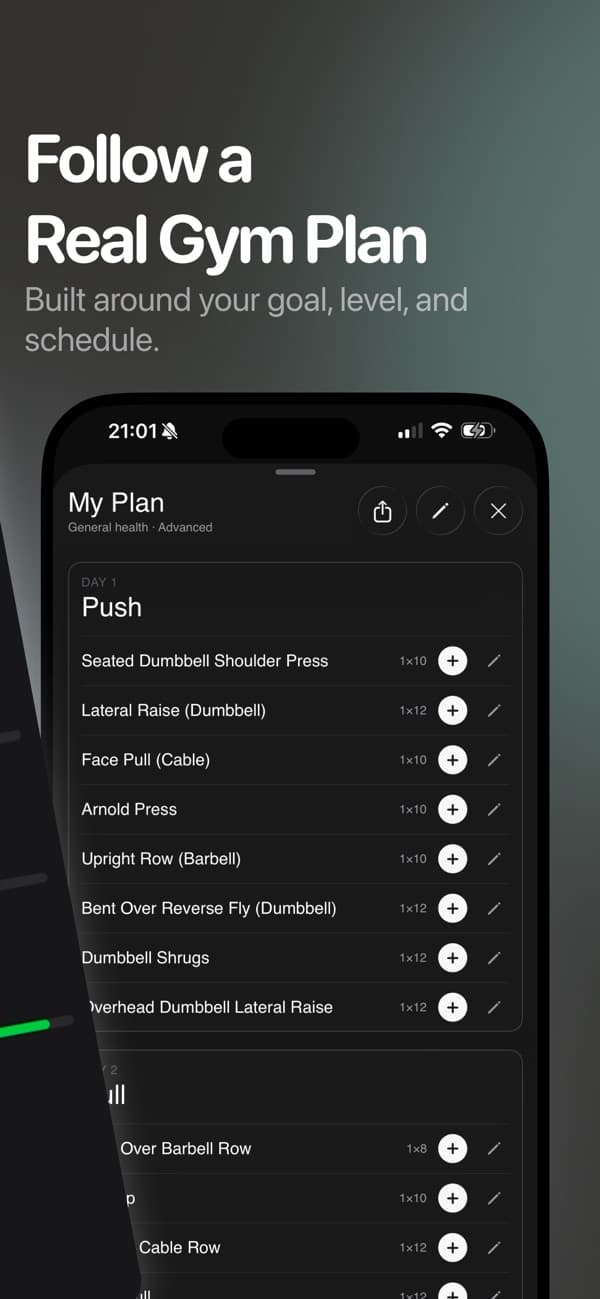
If you want a full program built around your days and equipment, the workout plan generator gives you a starting point.
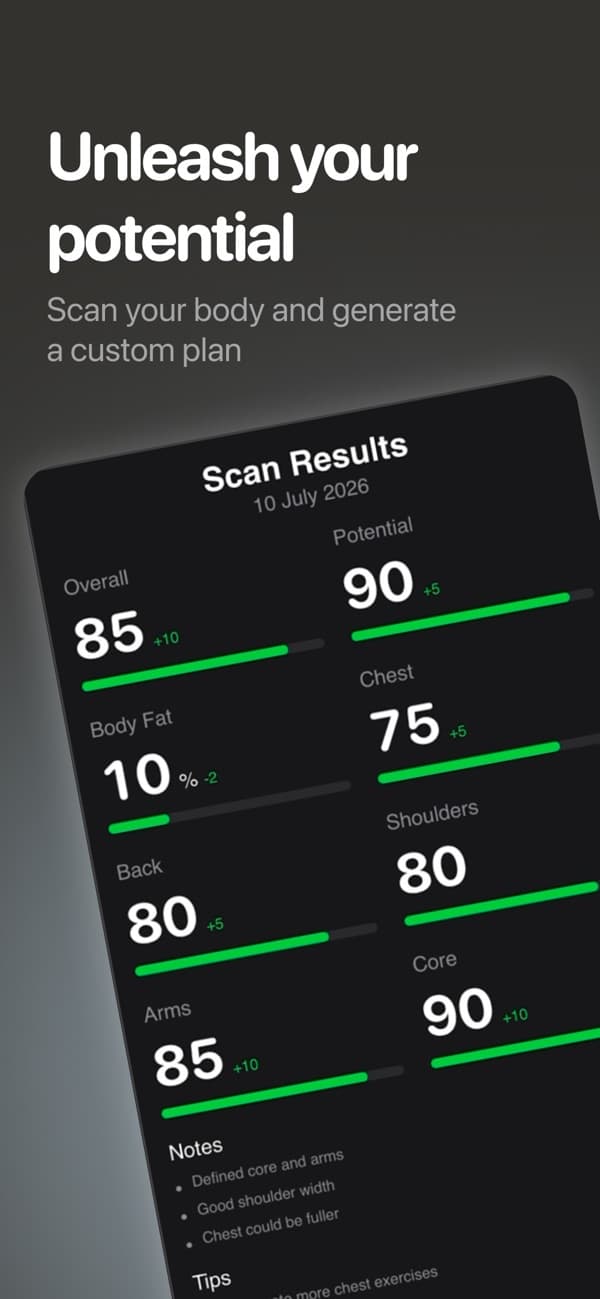

If you're not sure which muscles need more sets
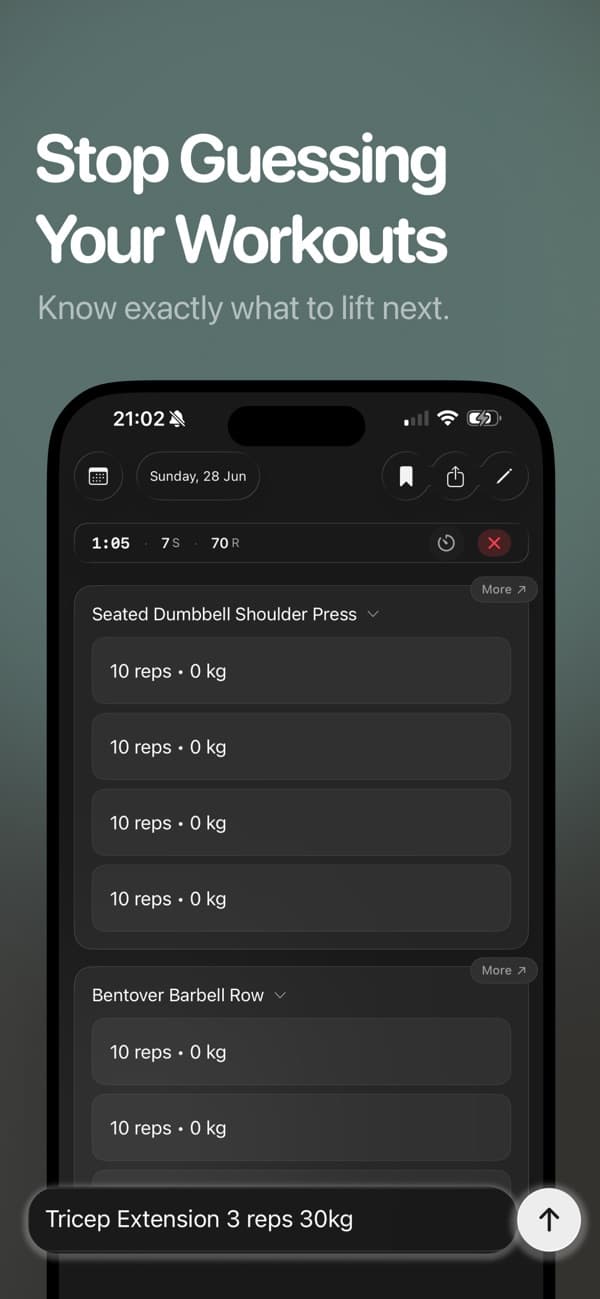
RepZet scans your body, rates each muscle and builds a plan around your weak points, so extra sets go where they're needed. You log sets by typing them like a message. (I make RepZet.)
How to find your own number
Studies report averages. Your best number depends on your training age, sleep, schedule and how close to failure you train. A simple way to find it:
- Start each muscle at about 10 hard sets per week.
- Track your main lifts. If the weight or reps keep going up, stay there.
- If a muscle has stalled for two or three weeks and you feel recovered, add two sets for that muscle.
- If performance drops, joints ache or you dread the session, go back to the last volume where you were progressing.
More sets is not the goal by itself. In one study of trained men, one, three and five sets per exercise all improved strength by similar amounts, while growth favored the higher volumes (Schoenfeld et al., 2019). If you mainly care about strength, you can get away with fewer sets than if you care about size.
Volume also doesn't replace progressive overload. Twenty sets with the same weight and reps every week give your body little new to adapt to. Keep adding reps or weight within those sets, for example with double progression.
Recovery and safety
Raise volume in small steps, two sets at a time, instead of doubling it overnight, so you can tell whether the extra sets help or just leave you tired. Warm up before your working sets, keep your technique the same as the sets get harder, and stop a set if you feel sharp pain. Normal muscle soreness that fades in a day or two is part of training. Pain in a joint that gets worse from week to week is a reason to reduce volume and, if it continues, to see a professional.
Count your hard sets for each muscle this week, and you'll know whether you need more, fewer or the same.
Frequently asked questions
Is 10 sets per week enough to build muscle?
Yes, for most people it is a good starting point. The ACSM's 2026 position stand found that muscle growth was enhanced with 10 or more sets per muscle group per week.
Do warm-up sets count toward weekly volume?
No. Count working sets that end close to failure. Warm-up sets are light on purpose and are left out of weekly totals.
Is 20 sets per muscle per week too much?
Not necessarily, but more sets give smaller extra gains. A 2026 meta-regression found that growth keeps rising with volume with diminishing returns, so only go above 20 if you recover well and keep progressing.
Should I train each muscle once or twice a week?
When weekly sets are the same, a meta-analysis found no meaningful difference in muscle growth between training frequencies. Most people find it easier to fit 10 or more good sets into two sessions than one.
Sources
- Schoenfeld BJ, Ogborn D, Krieger JW (2017). Dose-response relationship between weekly resistance training volume and increases in muscle mass: a systematic review and meta-analysis. Journal of Sports Sciences 35(11):1073–1082.
- Baz-Valle E et al. (2022). A systematic review of the effects of different resistance training volumes on muscle hypertrophy. Journal of Human Kinetics 81:199–210.
- Pelland JC et al. (2026). The resistance training dose response: meta-regressions exploring the effects of weekly volume and frequency on muscle hypertrophy and strength gains. Sports Medicine 56(2):481–505.
- Currier BS et al. (2026). ACSM Position Stand. Resistance training prescription for muscle function, hypertrophy, and physical performance in healthy adults: an overview of reviews. Medicine & Science in Sports & Exercise 58(4):851–872.
- Schoenfeld BJ, Grgic J, Krieger J (2019). How many times per week should a muscle be trained to maximize muscle hypertrophy? A systematic review and meta-analysis. Journal of Sports Sciences 37(11):1286–1295.
- Schoenfeld BJ et al. (2019). Resistance training volume enhances muscle hypertrophy but not strength in trained men. Medicine & Science in Sports & Exercise 51(1):94–103.
About the author
22, software developer and founder based in Madrid.
I'm Gabriel, I'm 22 and I live in Madrid. I write software, build my own products and I'm into maths, sport and fashion. Among other things I make three iPhone apps, Creatinely, LockTy and RepZet, and here I write about training, creatine and the small daily habits that add up.
This is general information, not medical advice. Talk to a professional about your own situation.
Keep reading
Double Progression Explained: When to Add Weight and How Much
Double progression: keep the weight, add reps until every set hits the top of your range, then add a little weight and start again. Rep ranges, jumps, examples.

How to Calculate Your One Rep Max (Epley and Brzycki Formulas, With a % Table)
Estimate your one rep max from a set of 10 reps or fewer with the Epley or Brzycki formula. Worked examples, a percentage table and when to test a true max.

How to Progressive Overload Without Adding Weight (6 Methods With Examples)
You can progressive overload without adding weight by doing more reps, adding sets, slowing the lowering phase or using a fuller range of motion. How and when.