How to Progressive Overload Without Adding Weight (6 Methods With Examples)
 Gabriel SánchezPublished
To progressive overload without adding weight, do more reps with the same load, add a set, slow down the lowering phase, train through a fuller range of motion or switch to a harder version of the exercise. More reps is the best supported option: in an 8-week study, lifters who kept the weight fixed and added reps built about as much muscle as lifters who added weight.
When adding weight isn't an option
There are plenty of reasons the bar can't get heavier this week. You train at home with a fixed pair of dumbbells. The next dumbbell up is 2 kg heavier, which is a 17% jump from 12 kg. You are coming back from a break. Or you have been stuck at the same weight for a month.

Progressive overload is broader than the number on the plate. The ACSM's position stand lists more reps at the current load, changes in tempo, rest periods and total volume alongside heavier loads as ways to increase the demand (ACSM, 2009). For the basics, see what progressive overload is.
1. Add reps
This is the most direct swap for adding weight. Plotkin and colleagues split 43 people with at least a year of lower-body training into two groups. Both started with weights they could lift for 8 to 12 reps. One group tried to add load while staying in that range. The other kept the starting load and tried to add reps each session. Both did four sets of four leg exercises twice a week for 8 weeks.
Muscle growth was similar between groups, with one thigh muscle slightly favoring the reps group. Squat strength slightly favored the load group by about 2 kg, which the authors called of questionable practical significance (Plotkin et al., 2022).
How to use it: pick a weight you can lift for around 8 reps with good form and aim for one more rep per set each week. Once you can do more than about 20 reps, each set takes a long time, so that is a good point to move to a harder variation.
2. Add a set
More hard sets per week tends to mean more growth. In a study of 34 trained men, groups doing one, three or five sets per exercise three times a week for 8 weeks all got stronger by a similar amount, but the higher-volume groups grew more in the arms and thighs (Schoenfeld et al., 2019).
How to use it: add one set to one exercise for the muscle you want to bring up, keep it for a few weeks, and only add another if you are still recovering between sessions. The guide on how many sets per week to build muscle gives the ranges, and the weekly sets calculator adds up what you are doing now.
3. Slow down the lowering phase
Taking two to three seconds to lower the weight makes a light load harder and stops you from bouncing out of the bottom. It has limits. A meta-analysis found that muscle growth was similar with rep durations from 0.5 to 8 seconds, and that very slow reps of more than 10 seconds seemed to be worse for growth (Schoenfeld et al., 2015).
How to use it: if 20 kg goblet squats feel easy at your normal speed, try a three-second descent and a short pause at the bottom. Write the tempo down, because a slow rep and a fast rep are not comparable from one week to the next.
4. Use a fuller range of motion
A deeper squat or a longer stretch on a Romanian deadlift makes the same weight harder. In a systematic review, training through a full range of motion led to more lower-body muscle growth than partial reps. For the upper body the evidence was limited and conflicting (Schoenfeld & Grgic, 2020).
How to use it: keep the weight, lower the box you squat to, or let the dumbbells go a little deeper on presses, as long as it feels comfortable on your joints and your technique holds. If a deeper position hurts, stay at the depth that doesn't.
5. Switch to a harder variation
When reps get too high, change the exercise to one that is harder with the same equipment:
Easier version | Harder version |
|---|---|
Push-up | Feet-elevated push-up |
Goblet squat | Bulgarian split squat with the same dumbbell |
Two-arm dumbbell row | One-arm row with a pause at the top |
Glute bridge | Single-leg hip thrust |
Inverted row with bent knees | Inverted row with straight legs |
Start the new version at the bottom of your rep range and build the reps up again.
6. Be careful with shorter rest
Cutting rest is often listed as a way to progress, and the ACSM does say shorter rest suits muscular endurance. For strength and power it recommends longer rest (ACSM, 2009). In trained men, 3-minute rest periods led to greater strength gains and more thigh growth than 1-minute rests over 8 weeks (Schoenfeld et al., 2016).
So if your goal is size or strength, keep rest long enough to repeat good sets, often two to three minutes on big lifts. Doing the same sets in less time is progress for conditioning, but it can cost you reps on the sets that matter.
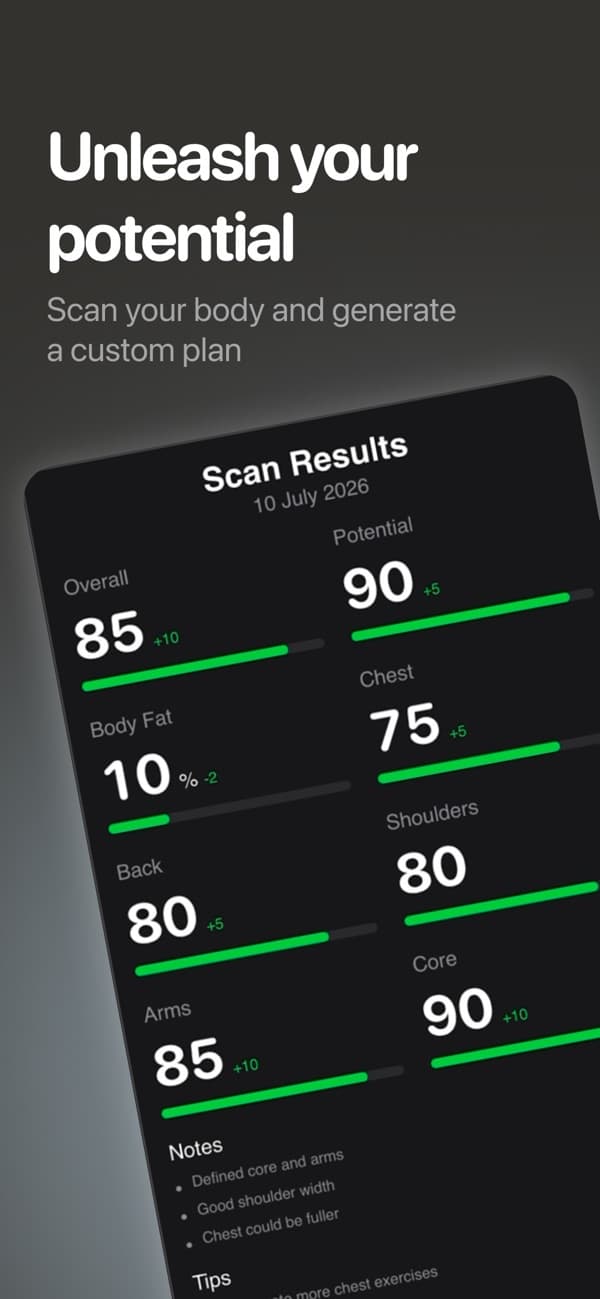
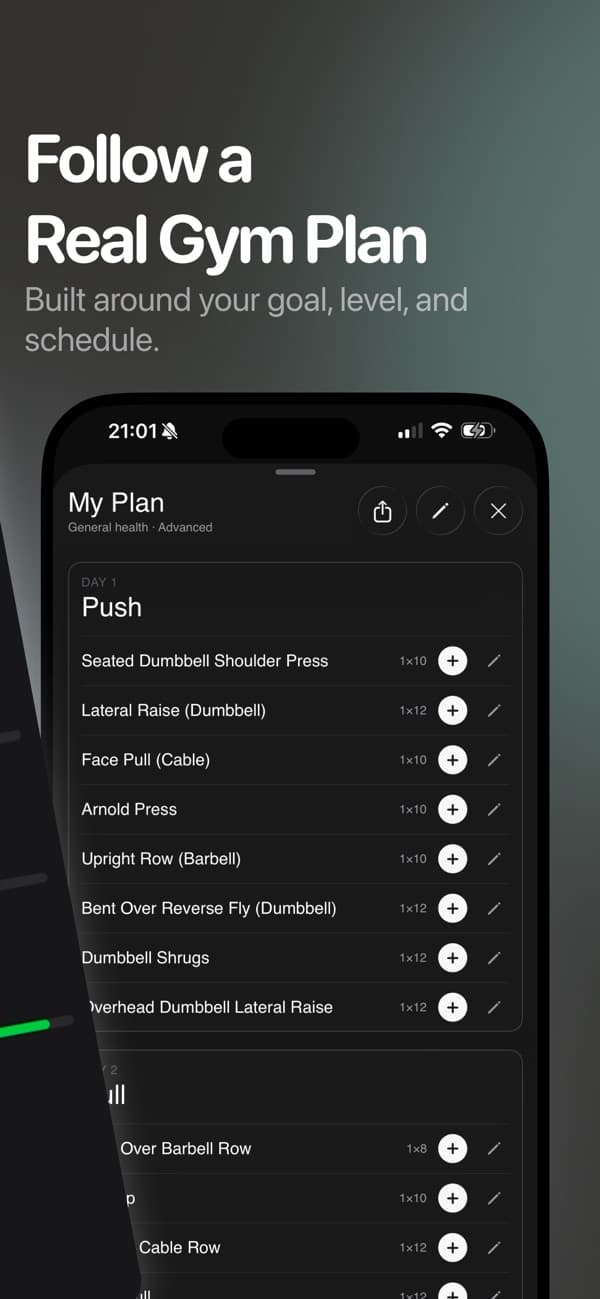
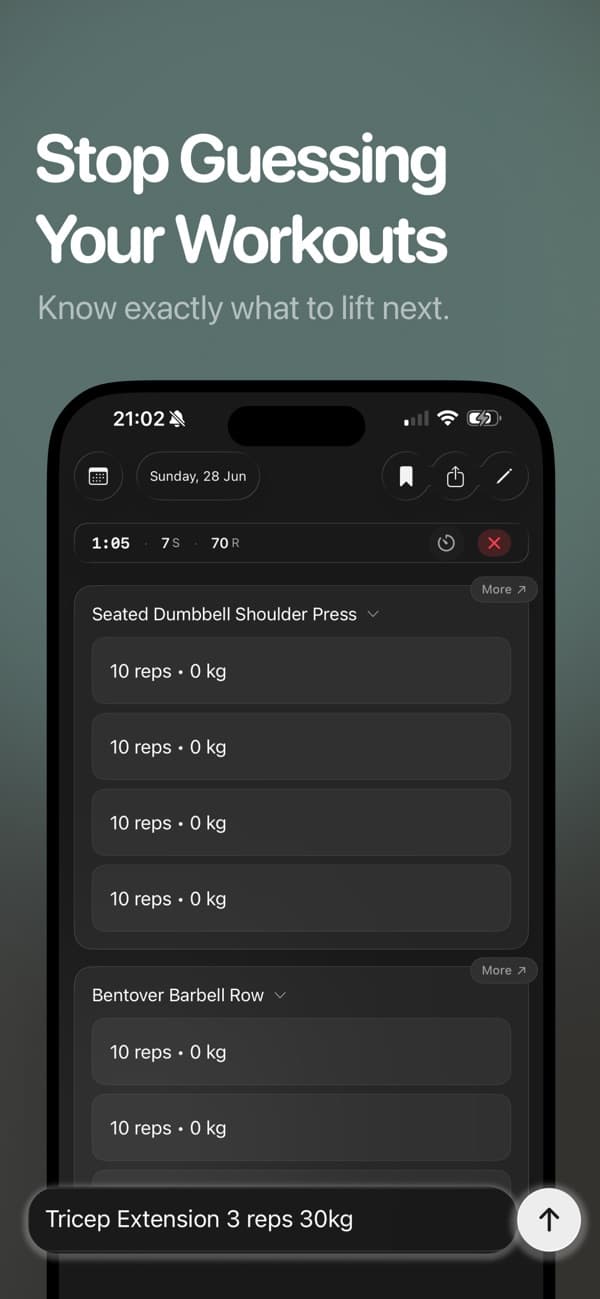

If you're adding reps, you need to remember them
RepZet lets you log a set by typing it like a message, keeps every rep you did last time in view, and suggests what to beat next session. (I make RepZet.)
Putting it together
You don't need every method at once. A simple order that works for most people:
- Add reps until you reach the top of your range on every set.
- If you still can't add weight, add one set to that exercise.
- When reps get too high, switch to a harder variation or slow the lowering phase.
- When you get access to heavier weights, go back to the normal approach: add weight and drop the reps.
That cycle of reps first and weight second is called double progression, and you can plan the numbers with the progressive overload calculator.
Whatever you change, keep the rest of the lift the same and warm up before your working sets. Stop a set if you feel sharp pain. The goal is to do a bit more than last week without getting hurt.
Write down today's reps and weight, and next session try to beat one of them.
Frequently asked questions
Can you build muscle without increasing the weight?
Yes. In an 8-week study of trained lifters, a group that kept the same weight and added reps built about as much leg muscle as a group that added weight (Plotkin et al., 2022). The sets still need to be hard.
Is slowing down the tempo a form of progressive overload?
It makes a fixed weight harder, so it can help when you can't add load. A meta-analysis found similar muscle growth with reps lasting anywhere from 0.5 to 8 seconds, so you don't need very slow reps to grow.
Does shortening rest periods count as progressive overload?
For muscular endurance, yes. For strength and size, a study in trained men found 3-minute rests led to more strength and growth than 1-minute rests, so cutting rest is not the best lever for those goals.
How many reps should I add before increasing the weight?
A common approach is to add reps until you reach the top of your rep range on every set, then add a small amount of weight. The ACSM suggests increasing the load once you can do one or two reps more than your target on two sessions in a row.
Sources
- Plotkin D et al. (2022). Progressive overload without progressing load? The effects of load or repetition progression on muscular adaptations. PeerJ 10:e14142.
- American College of Sports Medicine (2009). Progression models in resistance training for healthy adults. Medicine & Science in Sports & Exercise 41(3):687–708.
- Schoenfeld BJ et al. (2019). Resistance training volume enhances muscle hypertrophy but not strength in trained men. Medicine & Science in Sports & Exercise 51(1):94–103.
- Schoenfeld BJ, Ogborn DI, Krieger JW (2015). Effect of repetition duration during resistance training on muscle hypertrophy: a systematic review and meta-analysis. Sports Medicine 45:577–585.
- Schoenfeld BJ, Grgic J (2020). Effects of range of motion on muscle development during resistance training interventions: a systematic review. SAGE Open Medicine 8.
- Schoenfeld BJ et al. (2016). Longer interset rest periods enhance muscle strength and hypertrophy in resistance-trained men. Journal of Strength and Conditioning Research 30(7):1805–1812.
About the author
22, software developer and founder based in Madrid.
I'm Gabriel, I'm 22 and I live in Madrid. I write software, build my own products and I'm into maths, sport and fashion. Among other things I make three iPhone apps, Creatinely, LockTy and RepZet, and here I write about training, creatine and the small daily habits that add up.
This is general information, not medical advice. Talk to a professional about your own situation.
Keep reading
Double Progression Explained: When to Add Weight and How Much
Double progression: keep the weight, add reps until every set hits the top of your range, then add a little weight and start again. Rep ranges, jumps, examples.

How to Calculate Your One Rep Max (Epley and Brzycki Formulas, With a % Table)
Estimate your one rep max from a set of 10 reps or fewer with the Epley or Brzycki formula. Worked examples, a percentage table and when to test a true max.

How Many Sets per Week to Build Muscle? (What the Studies Say per Muscle)
Most research supports about 10 to 20 hard sets per muscle per week to build muscle. How to count sets, split them across the week and know when to add more.